The best overall puppy puzzle toy for most new owners is the KONG Puppy, with the Outward Hound Nina Ottosson (Level 1) and West Paw Toppl rounding out the shortlist. Here’s the quick version:
- KONG Puppy — best for teething pups; stuff it with peanut butter or kibble and it doubles as a calming training tool from week one
- Outward Hound Nina Ottosson (Level 1) — best first puzzle; beginner-friendly one-step compartments make it perfect for nose-work introduction in weeks 3–6
- West Paw Toppl — best slow-feeding introduction; freeze soft food inside for 15–20 minutes of lick-based enrichment
Introduce the KONG in your puppy’s first week home, swap in the Nina Ottosson around week three when your pup has settled, and add the Toppl once you’re ready to extend independent calm time.
Table of Contents
- Best puppy puzzle toys at a glance
- How to choose the right puzzle toy for your puppy
- Introduce puzzle toys the right way
- Safety, materials, and cleaning
- Short reviews: why each toy earned its spot
- Why mental enrichment matters for your puppy’s development
- Key Takeaways
- Puzzle toys are worth the effort, I promise
- Rebarkable’s 52-week program pairs perfectly with puzzle enrichment
- Useful sources and further reading
Best puppy puzzle toys at a glance
| Toy | Best For | Difficulty | Chew Resistance | Cleanability | Price (approx.) | Recommended Age |
|---|---|---|---|---|---|---|
| KONG Puppy | Teething, stuffing, calming | Easy | High (rubber) | Dishwasher-safe | $10–$15 | 8+ weeks |
| Outward Hound Nina Ottosson | Beginners, nose work | Level 1 (easy) | Low (plastic) | Dishwasher-safe | $12–$20 | 8+ weeks |
| Trixie Dog Activity | Supervised problem-solving | Easy–Medium | Low–Medium | Hand-wash | $15–$20 | 12+ weeks |
| West Paw Toppl | Slow feeding, licking | Easy | Medium–High | Dishwasher-safe | $15–$20 | 8+ weeks |
| PetSafe Busy Buddy | Adjustable challenge, slow feeding | Easy–Medium (tunable) | High | Hand-wash | $10–$20 | 12+ weeks |
U.S. price ranges are approximate retail. You’ll find all five at Amazon, Chewy, and most PetSmart or Petco locations. Prices shift with size variants, so check the manufacturer’s page for your puppy’s weight range.
Disclosure: This article may include affiliate links. Rebarkable earns a small commission at no extra cost to you. Always check manufacturer age guidance and materials before buying.
How to choose the right puzzle toy for your puppy
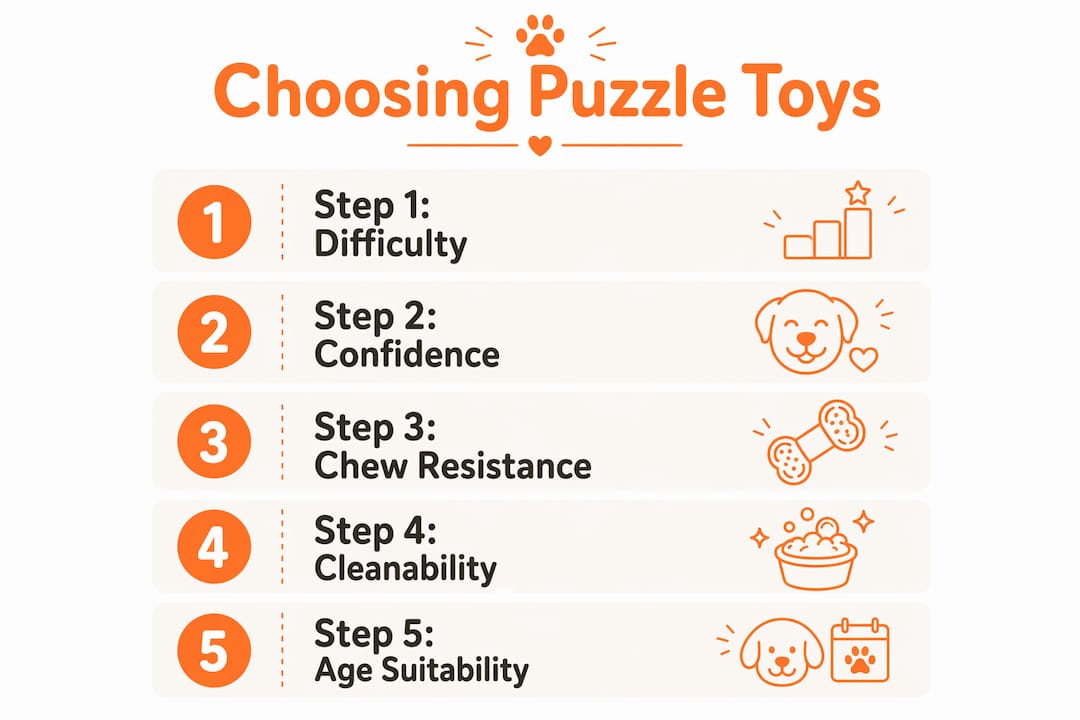
Not every toy suits every pup. Run through this checklist before you buy:
- Age and teething stage. Puppies 8–12 weeks are still developing jaw strength. Stick to soft rubber (KONG Puppy formula) or lick-based options. Hard plastic puzzles are better from 12 weeks onward, once teething is less intense.
- Size and jaw strength. A toy sized for a Chihuahua will frustrate a Lab puppy, and vice versa. Match the toy’s size recommendation to your pup’s current weight, not their adult weight.
- Previous puzzle exposure. Zero experience? Start at Level 1. Beginner puzzles focus on confidence-building, not difficulty, so your pup learns that puzzles equal rewards.
- Treat type and size. Small, soft treats from Moja-lekarna’s selection work best in most puzzles. Check our high-value treat guide for stuffing ideas that won’t spike daily calories.
- Cleanability. If you’re stuffing with wet food or peanut butter, dishwasher-safe wins every time.
- Adjustable difficulty. Toys like the PetSafe Busy Buddy let you widen or narrow treat openings, which means one toy can grow with your puppy for months.
Red flags that a toy isn’t right:
- Your puppy chews aggressively at the toy rather than problem-solving
- Pieces crack, splinter, or detach after a single session
- Your pup loses interest within 30 seconds and walks away (usually a sign the difficulty is too high, not that they dislike puzzles)
- Small parts are loose enough to swallow
Pro Tip: Match difficulty to your puppy’s confidence, not their age. A 16-week-old who has never seen a puzzle needs a Level 1 toy just as much as an 8-week-old does.
Introduce puzzle toys the right way
Getting this introduction right makes a real difference. A puppy who “doesn’t like puzzles” has usually just never been shown how to win at one.
- Fill every compartment. On the first session, load all slots or chambers completely. Your puppy should find a reward every single time they investigate.
- Demonstrate the mechanism. Slide a lid open yourself, let your pup sniff the treat, then reset it. Showing the puppy how it works before expecting them to figure it out cuts frustration dramatically.
- Keep sessions short. Five to seven minutes is plenty for a young puppy. End while they’re still engaged, not after they’ve given up.
- Supervise every session. Sit nearby, especially in the first week. You’re watching for safe use and also shaping behavior with calm praise when they succeed.
- Gradually reduce help. By session three or four, stop demonstrating. Let them work it out. Cheer them on when they get it.
- Increase difficulty slowly. Once your pup solves a Level 1 puzzle in under two minutes consistently, it’s time to move up or reduce the number of loaded compartments.
Aim for two to three puzzle sessions per day, ideally after a short walk or play session when your puppy is calm but not exhausted. Puzzles complement physical exercise; they don’t replace it. Pair enrichment with positive reinforcement training and you’ll see the confidence gains stack up fast.
Pro Tip: If your puppy walks away, don’t chase them with the toy. Reset it with even easier access and try again in 10 minutes. Frustration is the enemy of confidence.
Safety, materials, and cleaning
Before any puzzle hits the floor, run through this:
- Materials check. Look for BPA-free, non-toxic labeling. KONG and West Paw both publish material safety information. If a product doesn’t list materials, that’s a reason to pause.
- No detachable small parts. Anything a puppy can pry off and swallow is a choking hazard. Inspect the toy before and after every session.
- Manufacturer age guidance matters. It’s there for a reason. A toy rated for dogs 6 months and older has parts or a difficulty level that isn’t appropriate for a teething 10-week-old.
- Supervise first sessions. Manufacturers consistently advise against leaving puppies alone with treat-dispensing puzzles, especially plastic ones. Remove the toy once it’s empty.
- Inspect regularly. Cracks, chips, or warped plastic mean the toy is done. Replace it.
Cleaning: KONG Puppy and West Paw Toppl are both dishwasher-safe (top rack). The Nina Ottosson puzzles are also dishwasher-safe per Outward Hound’s guidance. Trixie boards and PetSafe Busy Buddy components are best hand-washed with warm soapy water and dried fully before storage. Damp puzzle boards grow mold fast, so air-dry completely.
Calorie note: Treats used in puzzles count toward your puppy’s daily intake. If you’re doing three puzzle sessions a day, reduce meal portions slightly to compensate.
Short reviews: why each toy earned its spot
KONG Puppy is the one toy worth buying before your puppy even comes home. The natural rubber formula is softer than the adult KONG, designed specifically for developing teeth and gums. Stuff it with safe, puppy-appropriate foods and freeze it overnight for a longer session. Buying caveat: size matters more here than with any other toy. Go by weight, not breed name.
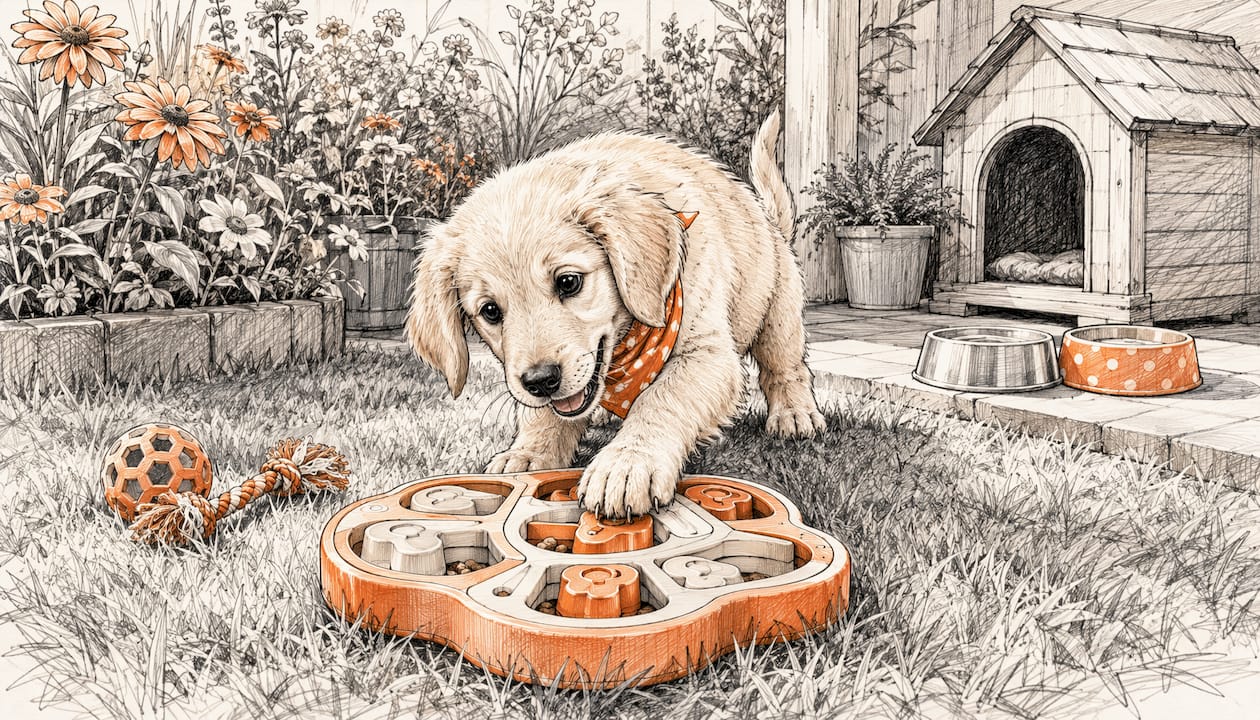
Outward Hound Nina Ottosson (Level 1) is the gold standard for first-time puzzle introduction. Level 1 puzzles use one-step solutions — a simple slide or lift — so puppies experience success immediately. Caveat: it’s plastic, not rubber, so it’s not a chew toy. Remove it the moment it’s empty.
Trixie Dog Activity (flip board) adds a layer of problem-solving with multiple small compartments that require both nose and paw work. It’s best introduced around weeks 6–8 of your training program, once your pup has basic puzzle confidence. Caveat: the multiple pieces need thorough hand-washing after every wet-food session.
West Paw Toppl shines as a lick-based enrichment tool. Fill it with plain yogurt, mashed banana, or softened kibble and freeze it. Licking activities are inherently calming and great for decompression after stressful events. Caveat: check the size chart carefully; the small Toppl is genuinely small.
PetSafe Busy Buddy is the longest-lasting option in the group because the adjustable treat openings let you dial difficulty up or down. It’s a good bridge toy between the easy early puzzles and more complex boards. Caveat: the tunable ring system has small components, so inspect it regularly.
As your puppy progresses, the natural sequence is: KONG and Toppl (weeks 1–4) → Nina Ottosson Level 1 (weeks 3–8) → Trixie flip board and Busy Buddy (weeks 6 onward). Rotate toys to keep things fresh rather than retiring them entirely.
Why mental enrichment matters for your puppy’s development
Mental stimulation is as critical as physical exercise for a growing puppy. Without it, boredom shows up as digging, excessive barking, and destructive chewing — your puppy isn’t being “bad,” they’re just under-stimulated. Puzzle toys give that brain something productive to do.
“Puzzle toys should be used alongside structured training programs to balance activity, rest, and brain work — not as a substitute for either.” — The Spruce Pets
The AKC notes that cognitively challenging toys — puzzles, snuffle mats, and treat-dispensing toys — build problem-solving skills and help puppies stay calm during independent time. Dogs who receive regular mental enrichment tend to display fewer anxiety-related behaviors and pick up training cues more quickly.
A practical weekly rhythm: use low-difficulty puzzles in the early weeks for pure confidence-building, then introduce intermediate puzzles and slow-feeders as your puppy masters basic obedience cues. Enrichment and structured training reinforce each other.
Key Takeaways
The KONG Puppy, Outward Hound Nina Ottosson Level 1, and West Paw Toppl cover the three most critical enrichment needs for a new puppy: teething relief, first puzzle confidence, and calming lick-based engagement.
| Point | Details |
|---|---|
| Start with the right difficulty | Use Level 1 or rubber stuffables in the first weeks; confidence matters more than challenge. |
| Supervise every session | Remove plastic puzzles once empty to prevent chewing and ingestion of parts. |
| Count puzzle calories | Treats used in enrichment count toward daily intake; adjust meals accordingly. |
| Progress deliberately | Move to harder puzzles only when your pup solves the current one in under two minutes. |
| Rebarkable’s 52-week plan | The program maps when to introduce each toy type, so enrichment and training build together. |
Puzzle toys are worth the effort, I promise
New puppy owners often tell me they tried a puzzle toy once, their pup ignored it, and they gave up. I get it. But nine times out of ten, the puppy wasn’t shown how to succeed. They needed a demonstration, a fully loaded board, and a little cheerleading. Once they get that first win, something clicks. You’ll see it in their body language — tail up, nose working, totally absorbed.
The other thing I’d push back on: don’t wait until your puppy is “ready.” A stuffed KONG on day one is never too early. These toys aren’t a reward for good behavior; they’re a tool for building it. Start small, stay consistent, and don’t stress if it takes a few sessions to land.
Rebarkable’s 52-week program pairs perfectly with puzzle enrichment
Picking the right toy is step one. Knowing when to introduce it, how to layer it into your training week, and what comes next — that’s where most new owners get stuck.

Rebarkable’s 52-week puppy training program delivers a structured weekly plan straight to your inbox, covering everything from potty training fundamentals to confidence-building enrichment schedules. Each week tells you exactly where your puppy should be developmentally and what to work on next, so puzzle toys slot into a real training timeline rather than sitting on a shelf. No guesswork, no generic advice — just practical, science-backed guidance sized for busy new owners. Sign up at Rebarkable and get your first week free.
Useful sources and further reading
- AKC: Puppy Exercise and Mental Stimulation — solid overview of enrichment activities from a trusted breed authority
- Guide Dogs for the Blind: Puppy Brain Games — practitioner-backed guidance on puzzle introduction and licking enrichment
- Outward Hound Nina Ottosson Level 1 — manufacturer’s own difficulty guide and age recommendations
- The Spruce Pets: Best Interactive Dog Toys — trainer-reviewed roundup with enrichment context
Always check the manufacturer’s age and size recommendations before buying, and supervise your puppy’s first few sessions with any new toy regardless of how “beginner-friendly” the label says it is.
Recommended
- 2024’s Best Puppy Toys – And They’re All On Amazon! – Rebarkable
- How to Set Up a Puppy Play Pen: From a Professional Dog Trainer – Rebarkable
- High Value Treats: The Complete Guide To Make Your Training Easy! (With A Recipe!) – Rebarkable
- How to Train Your New Puppy Not to Bite: A Trainer Explains – Rebarkable
![Why Does My Puppy Growl During Play? Pro Trainer Explains [2026]](https://westernfindsdaily.com/wp-content/uploads/2023/04/Blog-Headers-Q1-2023-7-400x250.png)
0 Comments