Your puppy will not “sleep when they’re tired”.
This is why I am crazy about sleep for dogs. Dogs in general, but particularly puppies, almost never get enough sleep and it’s something that dog guardians underestimate at every step of their journey with their dog.
Puppies sleep 18–20 hours per day in their first weeks home, and tonight you should expect at least one or two wake-ups for a potty trip. That is completely normal. The goal for the next few months is not perfect sleep right away; instead it is building a consistent routine that gradually stretches those nighttime .
Quick stats by age:
- 8 weeks to 6 months: 18–20 hours of sleep per day; 1–3 nighttime potty trips
- 7–12 months: 16–18 hours per day; aim for a 5–6 hour nighttime stretch
- 13 months & over: 14–16 hours per day; most nights consolidated to 6–8 hours
Tonight’s action: Do a final potty trip right before bed, keep the crate beside your bed, and use a calm, low-light wind-down. That single habit does more for nighttime sleep than almost anything else.
Table of Contents
- How much sleep does a puppy need at each age?
- Sample daily schedules you can copy right now
- How do you build a bedtime routine that actually sticks?
- Why enforced naps prevent the “crazy evening” behavior
- Where should your puppy sleep?
- Nighttime potty schedule and when puppies sleep through the night
- Common sleep problems and how to fix them fast
- Daily checklist to keep your puppy’s sleep on track
- Key Takeaways
- What actually works when routines meet real life
- Rebarkable makes the routine easier to stick to
- Useful sources and further reading
How much sleep does a puppy need at each age?
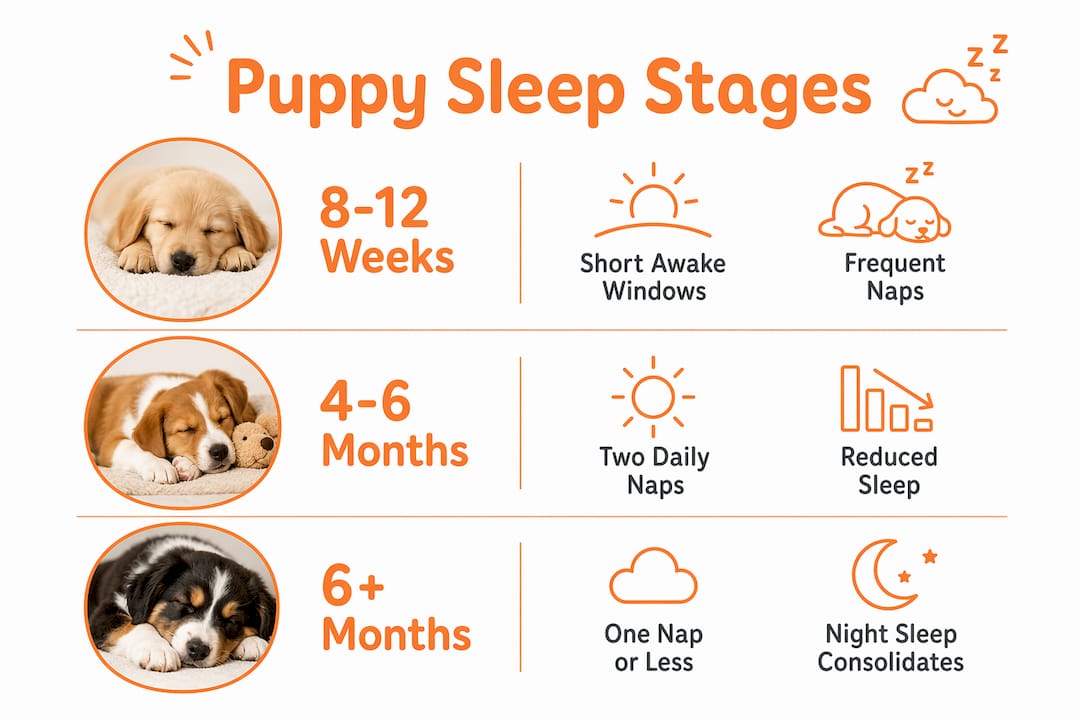
Sleep needs drop steadily as puppies grow, but the decline is slower than most new owners expect. A two-month-old puppy is not just a small dog; its brain and body are developing at a rate that demands enormous amounts of rest. Puppy sleep cycles are shorter than adult cycles, with more frequent REM-like active sleep, which is why you see twitching, paddling, and soft whimpering during naps.
| Age | Typical daily sleep | Nighttime stretch |
|---|---|---|
| Newborn–7 weeks | very long sleep periods | frequent waking |
| 8 weeks to 6 months | 18–20 hours per day | 1–3 nighttime wake-ups |
| 7-12 months | 16–18 hours per day | aim for a 5–6 hour nighttime stretch |
| 13 months and over | 14–16 hours per day | most nights consolidated to 6–8 hours |
The biological reason for all this sleep is straightforward: the immune system, musculoskeletal system, and brain all do their heaviest repair and growth work during rest. Cutting naps short does not make a puppy more tired at night; it usually makes them harder to settle.
Stat to know: Most puppies begin sleeping through the night consistently by 3–4 months, progressing from 1–3 nighttime wake-ups at 8–10 weeks to a 5–6 hour stretch by 12–14 weeks.
Pro Tip: Keep structured scheduled naps even when your puppy looks like a capable, bouncy four-month-old – these dogs get quickly overtired. Owners who drop nap enforcement at this stage almost always see evening regressions within a week.
Sample daily schedules you can copy right now
These are starting templates. Shift every clock time forward or back to match your household’s wake time; what matters is the spacing, not the exact hour.
8–12 weeks: short awake windows, frequent naps
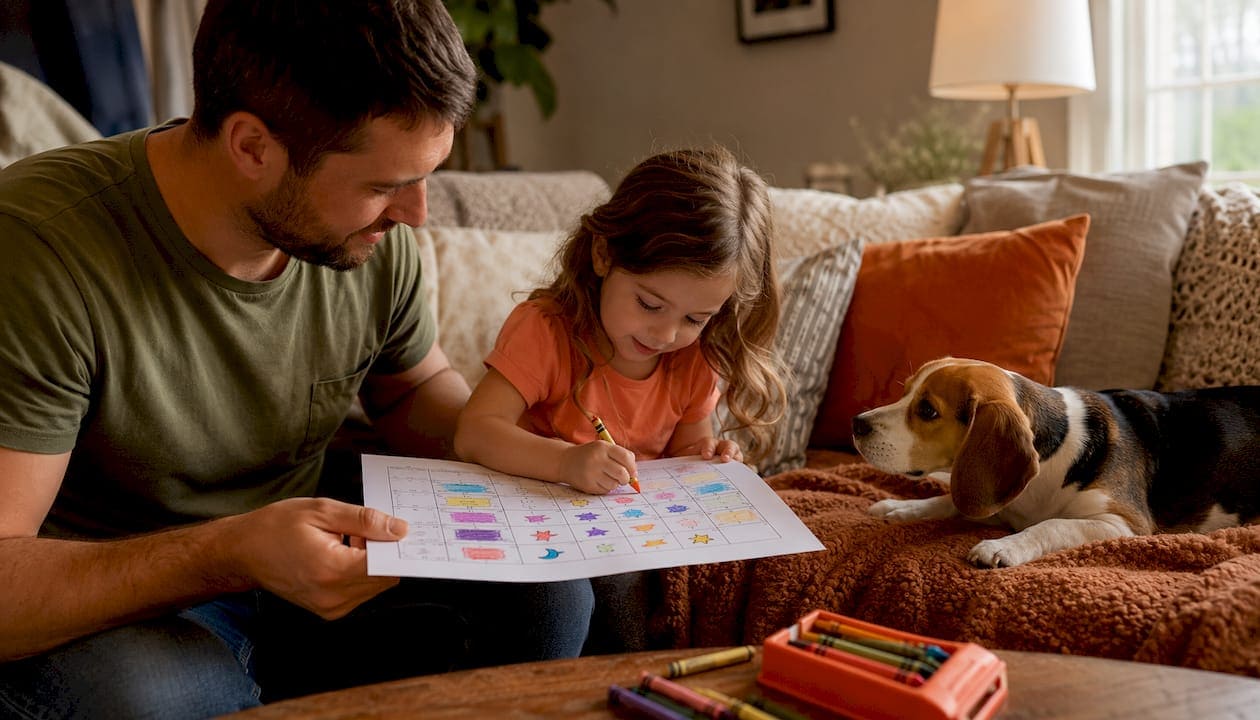
Young puppies can only handle about 45–60 minutes of activity before they need to rest. Napping after every play session is not spoiling them; it is meeting a genuine biological need.
Sample day (adjust start time to fit your schedule):
- 6:30 AM: Wake, immediate potty trip outside
- 6:45 AM: Breakfast, short play or training (10–15 minutes)
- 7:30 AM: Nap (1.5–2 hours in crate)
- 9:30 AM: Potty, play, brief socialization
- 10:30 AM: Nap (1–2 hours)
- 12:30 PM: Potty, lunch, calm play
- 1:30 PM: Nap (1–2 hours)
- 3:30 PM: Potty, play, light training
- 4:30 PM: Nap (45–60 minutes)
- 5:30 PM: Potty, dinner, calm interaction
- 6:30 PM: Short walk or gentle play
- 7:00 PM: Wind-down: dim lights, quiet crate time
- 7:30 PM: Final potty, bed
- Overnight: Expect 1–3 potty trips at 10:30 PM, 1:30 AM, and 4:00 AM
3–4 months: longer awake windows, fewer naps
Awake windows stretch to 1.5–2 hours. You can consolidate to three naps per day and start aiming for a 5–6 hour nighttime stretch.
- Morning nap: after breakfast and play (around 9:00–10:30 AM)
- Midday nap: after lunch activity (around 1:00–3:00 PM)
- Late afternoon nap: short one around 5:00–5:45 PM to prevent evening overtiredness
- Bedtime: 8:00–9:00 PM with a final potty at 10:30 PM
4–6 months and beyond
Two naps per day become the norm. The late-afternoon nap is the last to go, and dropping it too early is the most common cause of the “witching hour” meltdown at 6:00 PM. Nighttime stretches should reach 6–8 hours by five to six months for most puppies.

Pro Tip: If your schedule runs late (you work evenings), simply shift every block two hours forward. The puppy adapts to your rhythm, not a fixed clock, as long as the spacing between wake, eat, play, and nap stays consistent.
How do you build a bedtime routine that actually sticks?
Consistency is the mechanism. Puppies learn sleep cues the same way they learn sit: through repetition of a predictable sequence. A routine that takes 20–30 minutes and follows the same order every night will start working within a week.
- Cut stimulation 30 minutes before bed. No tug, no chase games, no excited greetings from family members.
- Last feeding 2–3 hours before bedtime to reduce overnight digestive urgency.
- Final potty trip right before the crate. Make it boring: leash, outside, back in. No play.
- Dim the lights in the room where the crate sits. Light is a powerful wakefulness signal for dogs.
- Use a consistent verbal cue — something like “Night puppy”, “bedtime” or “go to bed” said calmly every single night. Say it as you guide the puppy into the crate.
- Give a night-night treat – I swear by this. We give a final fairly large treat for the day, and leave them to it. This is part of our routine – no real science behind it, just seems nice
- Add a comfort item: a worn T-shirt or a snuggle toy with a heartbeat insert can reduce whining significantly in the first weeks.
- White noise or a fan at low volume masks household sounds that trigger alert barking.
- No re-engagement after lights out. If the puppy whines and it is not a potty emergency, wait. Responding to whining teaches the puppy that noise produces attention.
Pro Tip: Pick one phrase and one physical cue (like turning off the overhead light and switching to a lamp) and use both every single night. Within two weeks, the lamp switch alone will start making your puppy yawn.
Why enforced naps prevent the “crazy evening” behavior
The most counterintuitive fact about puppy sleep: overtiredness causes hyperactivity, not drowsiness. When a puppy misses a nap, cortisol and adrenaline build up, and by 6:00 PM you get zoomies, biting, and chaos that look like too much energy. It is actually the opposite.
Enforced or structured napping using predictable awake windows is the most effective way to break that cycle. The practical tool is the 1-up / 2-down rule: after roughly one hour of being awake, schedule a nap of about two hours. Do not wait for yawning, eye-rubbing, or slowing down. By the time those signs appear, the puppy is already overtired and settling will be harder.
How to enforce a nap:
- Place the puppy in the crate with a chew or Kong at the scheduled time, not when they seem tired
- Keep the crate in a low-traffic area during nap time
- Do not let the puppy out if they fuss; wait for a quiet moment, then open the door
- Avoid naps in your arms or on the couch if you want the crate to feel safe at night
When to call a vet about sleep: Occasional extra sleep during a growth spurt is normal. Contact a veterinarian if your puppy is difficult to rouse, shows labored breathing, or seems disoriented after waking. These can signal hypoglycemia, infection, or a neurological issue that needs prompt attention.
Where should your puppy sleep?
The short answer: wherever lets you hear a real potty signal without encouraging social play at 2:00 AM. Crate placement matters more than most owners realize.
Crate beside your bed (recommended for the first 8–12 weeks)
- You hear real distress vs. fussing without getting up and turning on lights
- The puppy smells and hears you, which reduces separation anxiety
- Easy to reach in and reassure without fully waking the puppy or yourself
- Fastest path to learning the difference between a potty wake-up and a boredom wake-up
Pen or crate in the bedroom but not bedside
- Works well once the puppy is settling reliably (around 10–12 weeks)
- Slightly more distance reduces the puppy’s ability to demand attention by pawing the crate
Separate room or common area
- Fine for older puppies (4+ months) who are sleeping through the night
- Harder to monitor real potty needs in the early weeks; not recommended before 12 weeks
Co-sleeping
- Not inherently harmful, but it removes the crate as a settling tool and makes nighttime potty monitoring harder
- If you choose this route, use a bed rail or low platform to prevent falls, and accept that potty training may take longer
Safety basics: Size the crate so the puppy can stand, turn, and lie down but not much more. A crate that is too large lets the puppy use one end as a bathroom. Use breathable bedding, keep the room between 65–72°F, and remove any collar or harness before crating to prevent snag hazards.
Nighttime potty schedule and when puppies sleep through the night
The bladder-hold rule of thumb is simple: a puppy’s age in months roughly equals the number of hours they can hold their bladder. A two-month-old: about two hours. A four-month-old: about four hours. Treat it as a guideline, not a guarantee, and always plan a final potty trip right before bed regardless of the math.
Nighttime potty frequency by age:
- 8–10 weeks: 2–3 trips per night (roughly every 2–3 hours)
- 10–12 weeks: 1–2 trips per night
- 12–16 weeks: Often down to one trip, usually around 3:00–4:00 AM
- 4–6 months: Many puppies sleep through the night with no trips needed
Keep overnight potty trips completely boring: leash on, outside, back in the crate, lights low. Any play, praise beyond a quiet “good,” or extended time outside teaches the puppy that waking you up is rewarding.
Signs progress is behind schedule: If a five-month-old puppy is still waking three or more times per night without a medical reason, revisit the last-potty timing, crate size, and daytime water access. Restricting water after 7:00 PM (while keeping daytime access unrestricted) often helps.
Vet red flags for nighttime waking: Frequent waking paired with excessive drinking, straining to urinate, or blood in urine warrants a vet visit. These can indicate a urinary tract infection, which is common in young puppies and easily treated.
Common sleep problems and how to fix them fast
Whining at night: Usually separation anxiety or a potty need. Rule out potty first (take out, no fuss, back in). If the crate is beside your bed, try placing a hand on the crate door without speaking. For persistent whining, Rebarkable’s guide on why puppies whine at night covers 16 specific strategies.
Refusing naps: The puppy is either not tired enough (awake window too short) or overtired (awake window too long). Adjust the schedule by 15 minutes in either direction and observe.
Sudden regression at 3–4 months: Almost always caused by dropping nap enforcement too early. Reinstate the afternoon nap for one week and the evening behavior usually corrects itself.
Excessive daytime sleep (hard to rouse): One or two extra-long naps during a growth spurt is normal. If the puppy is consistently difficult to wake, lethargic, or disoriented, contact a vet.
Night wake-ups after sleeping through: Check for environmental changes (new sounds, temperature shifts, a new family member). Also check whether the last potty trip moved earlier; even 30 minutes can make a difference.
Pro Tip: Keep a three-day sleep log: note wake times, nap lengths, and nighttime trips. Patterns become obvious fast, and you will stop second-guessing whether the schedule is working.
Daily checklist to keep your puppy’s sleep on track
Print this or screenshot it. Run through it each day until the routine is automatic.
Morning:
- [ ] Immediate potty trip within five minutes of waking
- [ ] Breakfast at the same time each day
- [ ] Play or training session (age-appropriate length)
- [ ] Crate nap enforced on the clock, not on tired signs
Midday:
- [ ] Potty after waking from nap
- [ ] Lunch (for puppies under four months)
- [ ] Second nap enforced after awake window
Afternoon:
- [ ] Short play or training session
- [ ] Late-afternoon nap (keep this until at least five months)
- [ ] Dinner 2–3 hours before bedtime
Evening:
- [ ] Cut stimulation 30 minutes before bed
- [ ] Dim lights, same verbal cue, same order every night
- [ ] Final potty trip right before crate
- [ ] White noise on, crate door closed
If traveling: Bring the crate and the same bedding. Shift nap times to match travel windows. The routine matters more than the location.
During a growth spurt or teething week: Expect one to two extra naps and possibly one additional nighttime wake-up. Do not abandon the schedule; just add the extra nap and return to normal when the spurt passes.
Key Takeaways
A consistent puppy sleep schedule built around enforced naps, a fixed bedtime routine, and age-appropriate potty trips is the single fastest path to full nights of sleep for both of you.
| Point | Details |
|---|---|
| Sleep totals by age | Puppy sleep totals decline steadily with age from very long durations in the youngest puppies toward adult sleep durations by one year. |
| Enforce naps on the clock | Use the 1-up/2-down rule; do not wait for tired signs or evening behavior worsens |
| Bladder-hold guideline | Age in months roughly equals hours the puppy can hold; always do a final potty before bed |
| Bedtime routine consistency | Same cue, same order, same time within 7 minutes every night speeds sleep consolidation |
| Rebarkable’s 52-week program | Stepwise weekly guidance covers sleep routines, crate training, and potty training together |
What actually works when routines meet real life
Most sleep advice for puppies reads like it was written for someone with no job, no kids, and infinite patience. Real households are messier than that, and that is fine.
The owners who make the fastest progress are not the ones who follow a schedule perfectly. They are the ones who pick two or three non-negotiables and protect those above everything else. For most families, those are: the final potty trip before bed, the crate-beside-the-bed placement for the first eight weeks, and the enforced nap after the first morning play session. Get those three right and the rest of the schedule can flex.
The 1-up/2-down rule is worth defending even on busy days. Skipping one nap rarely causes a disaster; skipping two in a row almost always produces a miserable evening. When life gets chaotic, stagger the responsibility: one family member handles the morning nap crate routine, another does the afternoon. The puppy does not care who puts them in the crate; they care that the crate happens.
Variability is also normal. Some puppies sleep through the night at ten weeks; others are still waking once at five months. Neither is a failure. The only thing that reliably slows progress is inconsistency, and even that is recoverable. A week of solid routine after a disruption usually resets things.
Rebarkable makes the routine easier to stick to
Getting the sleep schedule right is only one piece of the first year. Potty training, crate comfort, and behavioral patterns all feed into how well your puppy settles at night, and they all need to move forward together.

Rebarkable’s 52-week program delivers one focused training topic to your inbox each week, so you are never trying to tackle everything at once. The weeks covering crate training and potty training pair directly with the sleep routines in this guide, giving you the step-by-step structure to build on what is already working. If you are in the thick of night wake-ups right now, start there. The program meets you where you are, not where you think you should be. Head to Rebarkable to get your first week delivered.
Useful sources and further reading
The sources below are worth bookmarking. Each covers a different angle of puppy sleep and development.
- American Kennel Club: How Much Do Puppies Sleep? — Age-based sleep totals and what is normal for young puppies; a reliable first reference.
- Zoetis Pet Care: Understanding Your Puppy’s Sleeping Patterns — Explains puppy sleep architecture and why consistent routines matter biologically.
- Chewy: How Much Should Puppies Sleep? — Covers the bladder-hold guideline and practical overnight planning.
- Rover: How To Start Enforcing Puppy Naps — Practical nap enforcement strategies and sample timing for young puppies.
- Utah Humane Society: Puppy Survival Guide — The Importance of Sleep — Shelter-based perspective on sleep needs and settling new puppies.
- AKC Reunite: Understanding Your Dog’s Sleeping Patterns — Broader context on dog sleep stages and what disrupts healthy rest.
- Rebarkable: When Do Puppies Sleep Through the Night? — Timeline and practical steps for reducing nighttime wake-ups.
- Rebarkable: How Much Sleep Do Puppies Need? — In-depth age-by-age breakdown with signs of sleep problems to watch for.
Recommended
- What Time Should A Puppy Go To Bed? – Rebarkable
- How Much Sleep Do Puppies Need? An In-depth Guide – Rebarkable
- When Do Puppies Sleep Through The Night? – Rebarkable
- 11 Ways To Get Your Puppy To Sleep More And Stop Being Cranky – Rebarkable




0 Comments