If your dog loses their mind whenever the doorbell rings, the answer is not to keep ringing it and hoping they eventually get bored.
Nope! Instead, you need to make the whole picture easier. Start by reduce the surprise, teach them somewhere useful to go, and then rebuild the doorbell in small enough pieces that they can actually learn.
And just to set expectations properly, I am not usually aiming for a dog who never barks. A bark or two to tell you someone is at the door is perfectly reasonable. What we want to change is the bit that comes next: the frantic barking, charging the entrance, ignoring everything else and struggling to recover long after the visitor has come inside.
Why does the doorbell create so much barking?
The bell is rarely just a noise. It predicts footsteps, people moving quickly through the house, the door opening and somebody appearing. For some dogs that is worrying. For others it is wildly exciting. Plenty manage to feel both at once.
It is also a response dogs get to practise rather often. The bell rings, everybody rushes toward the entrance, the dog barks and the whole event becomes louder and faster. That repeated sequence gets very familiar, very quickly.
So before we train anything, we manage it. That is not cheating. It’s creating predictability and emotional regulation. It is how we stop adding another full-volume rehearsal while trying to teach a calmer response.
Step 1: Make real doorbell moments easier
For the next few weeks, take some pressure off. You might:
- put a note over the bell asking deliveries to be left without knocking;
- change or temporarily disconnect a smart doorbell chime;
- use a gate so your dog cannot reach the entrance;
- apply window film if seeing people approach is part of the problem; or
- keep a treat pot somewhere you can reach without running toward the dog.
If somebody arrives unexpectedly, you do not have to turn it into a training session. Scatter food away from the entrance, close a gate or settle your dog in another room. Real visitors are messy and distracting; controlled practice is where the learning happens.
Step 2: Choose what you want your dog to do instead
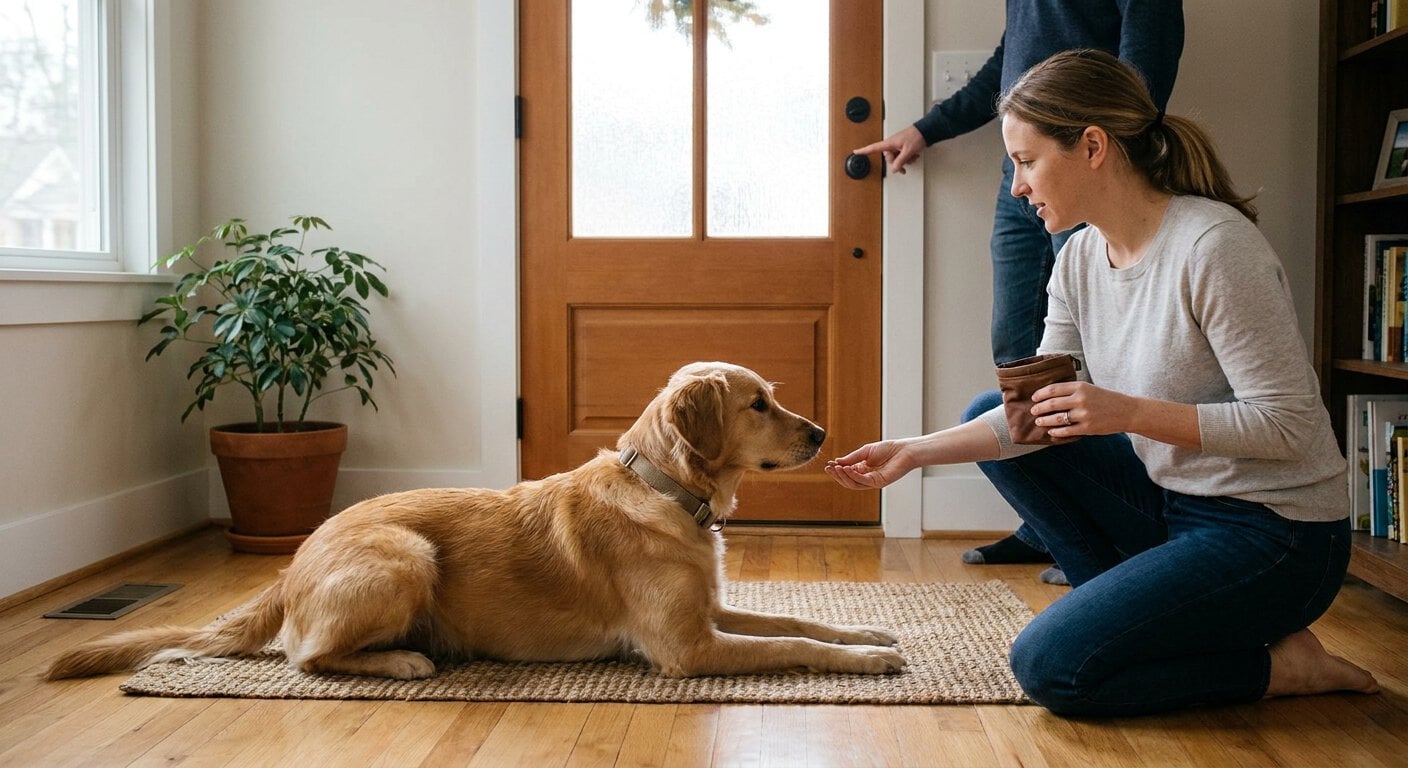
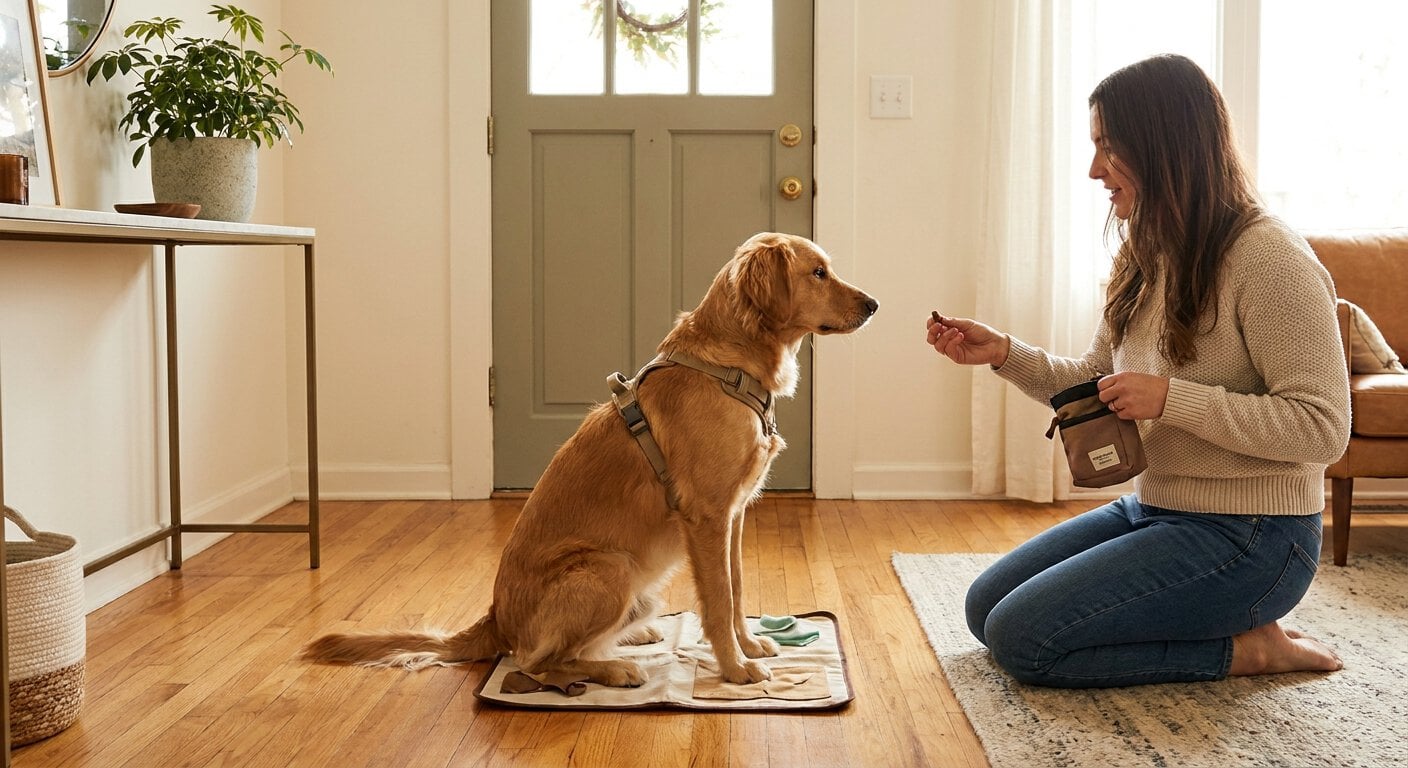
A mat or bed several feet from the door works beautifully for some dogs. It gives them a clear destination and keeps them out of the path of visitors. But it is not mandatory.
A dog who feels unsafe near the entrance may do better behind a gate, in a back room or following a food scatter away from the door. The useful alternative is the one your dog can actually perform when they are excited—not the one that looks most impressive on Instagram.
If you are using a mat, teach it before adding the doorbell:
- Place the mat in its normal position.
- Mark and reward any interest in it.
- Deliver several rewards on the mat so staying there pays better than stepping straight off.
- Add a cue such as “mat” only once your dog is already choosing to go there.
- Practise from different positions around the room, without visitors or door noises.
You can read more about positive reinforcement dog training here. At this stage, I want the mat to feel familiar and easy—not like a place the dog is sent after something scary happens.
Step 3: Start with a very quiet recorded doorbell
Find a recording that sounds reasonably similar to your bell and play it quietly from your phone. I mean genuinely quietly. If your dog barks, rushes toward the door, freezes, stops eating or becomes fixed on the sound, it was not an easy starting point.
Play the sound once, then give your dog something they value. That may be chicken, cheese, a small piece of hot dog or another food that suits their dietary needs. Some dogs will work perfectly happily for kibble; others will look at you as though you have fundamentally misunderstood the assignment. Reward value is decided by the dog.
Do three to five repetitions, then stop. Short and boring is useful here. We are trying to change what the sound predicts, not test how much your dog can tolerate.
This gradual process is usually described as desensitisation and counter-conditioning. In practical terms: make the trigger small enough that your dog can notice it without becoming overwhelmed, then pair it with something good.
When should you make it harder?
Move on when your dog can hear the sound, remain able to eat and bring their attention back to you for several repetitions. Then change one thing: raise the volume slightly, move the speaker, or ask for the station. Do not increase all three at once.
If your dog barks or runs to the door, that is information, not failure. Lower the volume or simplify the setup next time.
Step 4: Add your movement toward the door
Dogs notice the entire routine. Your phone making a tiny “ding” while you sit on the sofa is not the same as the real bell followed by you leaping up and hurrying toward the entrance.
Once the recording is easy, play it and make a small movement: shift forward in your chair, stand up, or take one step toward the door. Reward your dog for staying engaged with you or moving to their station. Build gradually until you can walk to the entrance, touch the handle and briefly open the door.
Again, one change at a time. If you make the bell louder, walk to the door and swing it open in the same repetition, you have not created a useful training step. You have recreated the original problem.
Step 5: Practise with a helper
Ask a familiar, patient person to help. Have them text when they arrive so you can set up before they ring. Start with the dog behind a gate or on their station, then ask the helper for one quiet knock or ring.
Reward the response you are building. A dog who gives one bark and then turns back to you has made a very good choice. We do not need to withhold food because the first second was not perfect.
Keep the visitor outside at first. Later, they can open the door slightly, step inside and eventually move through the hallway. Dogs Trust also has useful guidance on preparing dogs for visitors.
What about homes with more than one dog?
Train them separately first. I have multiple dogs in my own home, and once one starts, the others can join in before they have even worked out what they are barking at. Trying to teach three excited dogs at the door simultaneously is less “advanced dog training” and more an avoidable headache.
Give the other dogs something appropriate to do elsewhere, train one dog at a time, and combine them only after each understands the routine individually. They may eventually share a station, but separate beds or separate sides of a gate are often clearer.
Common doorbell-training mistakes
- Practising at full intensity. Repeatedly ringing the real bell while the dog explodes is testing, not training.
- Moving too quickly. Progress is not measured by how loud you can make the sound today.
- Demanding a sit from a dog who cannot disengage. If your dog cannot eat or look away from the entrance, make the situation easier before asking for more behaviour.
- Shouting over the barking. Even if your dog knows “quiet” elsewhere, adding another loud voice usually adds arousal rather than clarity.
- Using aversive tools. They may interrupt barking, but they do not teach the dog what to do when the bell rings and can create further concern around the doorway. Rebarkable has a fuller explanation of why I do not recommend aversive training, and the AVSAB humane training statement recommends reward-based methods.
Will treats reward the barking?
Food does not automatically reinforce every behaviour happening around it. Timing and context matter. In these planned sessions, the bell predicts food and your dog learns an alternative response. During a real surprise, a food scatter can also help move the dog away and bring arousal down enough for you to manage the door.
If you repeatedly wait for a dog to bark directly at you and then deliberately feed that particular behaviour, yes, you could strengthen it. That is not what this plan asks you to do.
How long will doorbell training take?
There is no honest universal answer. A puppy with a fairly mild response may improve quickly. A dog with years of rehearsal, fear around visitors or broader reactivity around people entering the home will need a slower plan.
Watch recovery rather than chasing silence. Fewer barks, a quicker turn back toward you, staying able to eat and settling sooner after the visitor enters are all meaningful progress.
The realistic goal
Your dog does not need to become silent to be successful. They need a response that is safer, shorter and easier to recover from. Manage the unpredictable arrivals, practise the controllable pieces and increase difficulty only when the current version genuinely looks easy.
That approach is not flashy, but it is repeatable—and repeatable training is usually the training that works.





0 Comments