The fastest way to stop puppy barking is to manage the trigger right now, then spend five minutes a day teaching a “quiet” cue using positive reinforcement. That two-part approach, immediate management plus a short daily training routine, produces noticeable results within days and lasting quiet behavior within weeks.
Here is what you can do in the next 20 minutes:
- Remove or reduce the trigger. Close the curtains if your puppy barks at passersby, or move them away from the window.
- Redirect before the bark escalates. Hand them a chew toy or ask for a sit the moment you see them tense up.
- Allow up to three barks, then cue “quiet.” The three-bark rule lets your puppy alert you before you step in calmly.
- Turn your back for attention-seeking barking. The instant they stop, even for one second, mark that silence with a calm “yes” and reward.
- Run two five-minute training sessions today. Morning and evening, consistent timing builds the habit faster than one long session.
Your daily plan: two short sessions, a doorbell drill (more on that below), and a calm pre-bed routine. That is the whole program in one sentence.
Pro Tip: When you stop rewarding demand barking, expect an extinction burst: your puppy will bark harder and longer before the behavior drops. Stay consistent. If you give in during the burst, you teach them that louder barking works.
Table of Contents
- Why is my puppy barking so much?
- How to stop puppy barking in the moment
- Teaching your puppy the “quiet” cue step by step
- Prevention: exercise, enrichment, and socialization
- When barking is a red flag: medical causes and when to call a professional
- How to use the crate to reduce nighttime barking
- Common owner mistakes that make barking worse
- How Rebarkable supports long-term barking reduction
- Key Takeaways
- A trainer’s honest take on puppy barking
- Ready to make quiet the new normal?
- Useful sources
Why is my puppy barking so much?
Not all barking is the same, and treating every bark with the same response is one of the most common mistakes new owners make. Diagnosing the type first saves you weeks of frustration.
The main causes, and what each one tells you:
- Attention-seeking/demand barking. Your puppy has learned that barking gets a response, any response, including scolding. This is the most trainable type.
- Alarm/territorial barking. Triggered by sounds, strangers, or movement outside. Often sharp and repetitive.
- Boredom barking. Sustained, monotonous, and usually happens when your puppy has been alone or unstimulated for too long.
- Play/excitement barking. High-pitched, often paired with bouncing or spinning. Usually short-lived.
- Fear/anxiety barking. Lower, more urgent, often accompanied by tucked tail, flattened ears, or attempts to hide.
- Teething or medical discomfort. Whining or barking that seems unprovoked and is paired with restlessness, pawing at the mouth, or changes in appetite.
Some causes demand immediate prevention. Alarm barking, for example, gets worse the more your puppy rehearses it, so blocking the trigger matters right away. Boredom barking, on the other hand, calls for enrichment and exercise rather than a training script. Fear-based barking needs desensitization, not correction.
Statistic note: Veterinarians and certified behaviorists consistently recommend ruling out medical causes before starting any behavior modification, and they favor positive reinforcement over punitive methods across all bark types.
Puppies do not simply grow out of excessive barking if the behavior is reinforced. Early intervention during the socialization window makes a measurable difference.
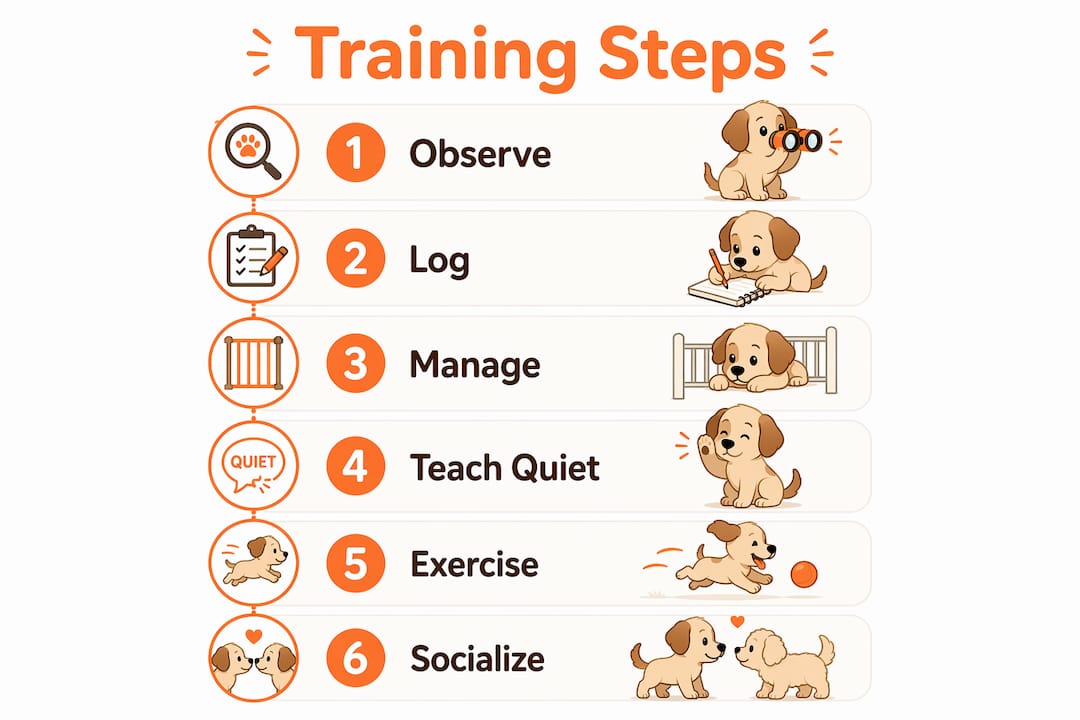
Log your puppy’s barking for three days. Note the time, location, trigger, duration, and your response. Patterns emerge quickly, and that log becomes useful if you ever consult a trainer or vet.

| Bark type | Primary trigger | Best first response |
|---|---|---|
| Attention-seeking | Owner presence, inactivity | Ignore, then reward silence |
| Alarm/territorial | Sounds, movement outside | Block stimulus, teach “quiet” cue |
| Boredom | Understimulation, isolation | Exercise, puzzle feeders, enrichment |
| Fear/anxiety | Unfamiliar people, sounds | Desensitization, counter-conditioning |
| Medical/teething | Internal discomfort | Vet check first |
How to stop puppy barking in the moment
Speed and calm matter here. The goal is to interrupt the bark without accidentally rewarding it or escalating it.
- Identify the trigger before you move. Rushing toward your puppy while they bark can look like excitement to them. Pause, assess, then act.
- Remove or reduce the stimulus. Close curtains, step between your puppy and the window, or use a radio or white noise machine to mask outdoor sounds. This is not a long-term fix, but it stops the rehearsal immediately.
- Redirect to an incompatible behavior. A puppy cannot bark and sniff a stuffed Kong at the same time. Hand them a chew, scatter kibble on the floor, or ask for a known behavior like “sit.”
- For attention-seeking barking: planned ignore. Turn your back or leave the room the moment barking starts. No eye contact, no talking, no touching. Return only when they are quiet.
- Mark and reward the first second of silence. The timing here is everything. A calm “yes” or a click the instant the barking stops tells your puppy exactly what earned the treat.
What not to do:
- Yell “no” or “quiet” repeatedly. To a barking puppy, yelling reads as joining in, not correcting.
- Physically push or startle your puppy. This adds stress and can trigger fear-based barking.
- Use punishment collars, spray devices, or ultrasonic deterrents without professional guidance. These rely on positive punishment, can cause harm, and are often less effective than positive reinforcement methods.
- Give in to demand barking “just this once.” One concession resets the extinction process.
Pro Tip: Keep a small treat pouch near the spots where barking most often happens, like by the front door or the living room window. The faster you can reward silence, the clearer the lesson.

Teaching your puppy the “quiet” cue step by step
Here is the counterintuitive part: teaching “speak” first makes “quiet” significantly easier to shape. When you can trigger a bark on cue, you control the moment you ask for silence, which means you can reward it precisely. The AKC confirms this sequence produces a more reliable “quiet” than trying to catch silence randomly.
Phase 1: Teach “speak”
- Find what reliably makes your puppy bark: a knock on the door, a doorbell sound from your phone, or a squeaky toy.
- Trigger the bark, then immediately say “speak” in a calm, even tone.
- Mark the bark with “yes” or a clicker and deliver a treat.
- Repeat 5–10 times per session until your puppy barks on the word alone.
Phase 2: Teach “quiet”
- Cue “speak.” Let your puppy bark once or twice.
- Say “quiet” calmly. Hold a treat near their nose without giving it.
- The moment they stop barking to sniff the treat, mark with “yes” and reward.
- Gradually increase the duration of silence required before the reward: one second, then three, then five.
- Practice in short bursts, 5 minutes maximum, twice a day.
The doorbell drill:
- Ring the doorbell (or play a doorbell sound on your phone).
- Allow two to three barks.
- Say “quiet,” lure with a treat if needed, and reward silence.
- Repeat 5–8 times per session. Most puppies show improvement within 10–15 repetitions spread across two or three days.
Troubleshooting:
- Puppy won’t bark on cue. Use a higher-value trigger, like a knock on the door, or practice when your puppy is already slightly aroused from play.
- Puppy escalates instead of calming. Lower the difficulty. Reward shorter silences, reduce the intensity of the trigger, and build duration more slowly.
Pro Tip: If your puppy starts barking harder when you introduce “quiet,” that is the extinction burst at work. Do not raise your voice or repeat the cue. Say it once, wait, and reward the first pause, however brief.
Prevention: exercise, enrichment, and socialization
Excessive barking frequently signals unmet needs: boredom, insufficient exercise, or anxiety. Fix the underlying conditions and the training becomes much easier.
Daily enrichment checklist:
- At least one physical exercise session matched to your puppy’s age (5 minutes per month of age, twice daily, is a widely used guideline for leash walks).
- One puzzle feeder or snuffle mat at mealtime instead of a bowl.
- A scent game: hide kibble around a room and let your puppy find it.
- A chew session with an appropriate chew toy to satisfy oral needs, especially during teething.
- Short training sessions count as mental exercise and tire puppies out faster than physical play alone.
Socialization and habituation:
Socialization and habituation reduce fear- and anxiety-based alarm barking by building your puppy’s confidence around unfamiliar sounds, people, and animals. The critical socialization period closes around 12–16 weeks, but exposure work continues to pay off well beyond that window.
Safe exposure steps:
- Start with low-intensity versions of triggers: a recording of traffic at low volume, a stranger at a distance.
- Pair every exposure with something your puppy loves: a treat, a toy, calm praise.
- Increase intensity only when your puppy is relaxed at the current level.
- For shy puppies, a step-by-step socialization plan that moves at their pace prevents the fear from compounding.
Timeline expectations:
| Timeframe | What to expect |
|---|---|
| Days 1–3 | Barking may increase briefly (extinction burst) before dropping |
| Week 1–2 | Puppy begins responding to “quiet” cue in low-distraction settings |
| Week 3–4 | Noticeable reduction in frequency with consistent daily practice |
| Month 2–3 | Reliable “quiet” in most situations; enrichment reduces boredom barking |
| Month 3+ | Socialization gains compound; alarm barking decreases with habituation |
Build predictable daily routines. Puppies that know when to expect exercise, meals, and training sessions are calmer between those windows and less likely to bark for stimulation.
When barking is a red flag: medical causes and when to call a professional
Some barking is not a training problem. Recognizing the difference early saves time and protects your puppy’s welfare.
Red flags that warrant a vet call first:
- Sudden onset of barking with no obvious trigger, especially in a previously quiet puppy.
- Changes in bark quality: hoarser, higher-pitched, or strained.
- Barking paired with other signs of pain: limping, reluctance to move, pawing at the face or ears, changes in eating.
- Nighttime distress that includes pacing, panting, or inability to settle despite a calm environment.
- Obsessive or repetitive barking that does not respond to any redirection.
- Destructive behavior alongside barking, which can signal separation anxiety severe enough to need professional support.
When to consult a certified behaviorist:
If barking is rooted in severe fear, separation anxiety, or aggression, a certified professional dog trainer (CPDT) or a board-certified veterinary behaviorist (Dip ACVB) is the right next step. Positive reinforcement training alone may not be enough for clinical-level anxiety.
Pro Tip: Before your appointment, record two or three video clips of the barking episodes on your phone. Note the time, duration, and what happened immediately before. That context cuts a vet or trainer consultation time in half and leads to a more accurate assessment.
How to use the crate to reduce nighttime barking
A crate is not a punishment. Used correctly, it becomes your puppy’s preferred resting spot, and that shift alone dramatically reduces nighttime whining and early-morning barking. Rebarkable’s crate training resource center covers the full process, but here is the core nighttime plan.
Crate setup:
- Place the crate in your bedroom, at least for the first few weeks. Proximity reduces separation anxiety.
- Cover three sides with a blanket to create a den-like feel and block visual stimulation.
- Add a worn T-shirt or a heartbeat comfort toy to provide familiar scent and sound.
Nighttime routine:
- A short exercise or play session 30–60 minutes before bed to burn off energy.
- A final potty trip immediately before crating.
- Dim the lights and lower household noise as a settling cue.
- Place your puppy in the crate with a chew or a stuffed Kong to occupy them for the first few minutes.
- Use white noise or a fan to mask outside sounds that might trigger alarm barking.
What not to do at night:
- Do not let your puppy out of the crate the moment they bark. Wait for a pause, even a brief one, then release.
- Do not move the crate to a different room each night. Consistency in location speeds settling.
- Do not skip the pre-bed potty trip. A puppy that needs to eliminate will bark, and that bark is legitimate.
Pro Tip: Increase alone time in the crate gradually during the day before expecting full nights. Start with five minutes, then ten, building up over several days. A puppy that is comfortable in the crate during the day settles faster at night.
Common owner mistakes that make barking worse
Most barking problems are accidentally created by well-meaning owners. The good news: the fixes are straightforward once you see the pattern.
The most common mistakes and their fixes:
- Yelling “no” or “quiet” repeatedly. Yelling is attention, and to a puppy, attention is a reward. Replace with a single calm cue, delivered once.
- Giving in to demand barking. Handing over a toy or treat to stop the noise teaches your puppy that barking works. Ignore the bark, reward the silence.
- Inconsistent household rules. If one family member rewards barking and another ignores it, the puppy learns to bark at the person who gives in. Everyone in the house needs the same response plan.
- Accidentally rewarding with eye contact or talking. Even saying “shh” counts as attention. Use body language: turn away, cross your arms, leave the room.
- Using punishment devices without professional guidance. Spray collars, shock collars, and ultrasonic devices can suppress barking temporarily but often increase anxiety and redirect the problem. The risks of punishment-based training are well-documented and worth understanding before reaching for a device.
- Practicing too infrequently. One training session a week produces almost no change. Two five-minute sessions daily, every day, is the minimum for measurable progress.
A simple household consistency plan:
- Write down the three-word rule for your home: “Ignore the bark.”
- Agree on the cue word everyone will use: “quiet” works well because it is short and calm.
- Agree on the reward: a small treat or calm praise the instant barking stops.
- Post it on the fridge. Seriously. New habits need reminders.
How Rebarkable supports long-term barking reduction
Knowing what to do and actually doing it consistently for weeks are two different things. That gap is where most new owners lose progress.
Rebarkable’s 52-week program delivers weekly training lessons directly to your inbox, covering barking, impulse control, socialization, and the full range of puppy behavior challenges in a structured sequence. Each week builds on the last, so you are not guessing what to work on next.
What the program includes for barking specifically:
- Step-by-step behavior modules covering demand barking, alarm barking, and nighttime whining.
- Video demonstrations of the “speak” and “quiet” training sequence.
- Weekly expert tips timed to your puppy’s developmental stage.
- Community support from other owners going through the same challenges.
- Troubleshooting guidance when progress stalls.
The science-backed, positive reinforcement approach runs through every module, so you are never asked to use punishment or suppression tools.
Pro Tip: The owners who see the fastest results with Rebarkable are the ones who treat the weekly lesson like a standing appointment. Ten minutes on Tuesday morning, every week, beats an intense weekend session followed by nothing.
Key Takeaways
Consistent daily practice combining immediate management with a “speak-then-quiet” training sequence produces measurable barking reduction within one to four weeks for most puppies.
| Point | Details |
|---|---|
| Manage the trigger first | Close curtains, use white noise, or redirect before barking escalates. |
| Teach “speak” before “quiet” | Controlling when your puppy barks makes it far easier to reward silence precisely. |
| Expect an extinction burst | Barking often intensifies briefly when you stop rewarding it; consistency through this phase is critical. |
| Prevention beats correction | Daily exercise, puzzle feeders, and socialization reduce the underlying drivers of barking. |
| Rebarkable’s 52-week program | Weekly structured lessons and expert troubleshooting keep training consistent beyond the first few days. |
A trainer’s honest take on puppy barking
New owners often come to barking training expecting a quick fix, and the frustration when it does not arrive in 48 hours is real. Here is what actually matters: the method is less important than the consistency. A perfectly designed training script practiced twice a week will lose to a simpler approach practiced twice a day, every day.
The other thing worth saying plainly: puppies bark. The goal is not silence. It is a puppy that responds to a calm “quiet” cue and has enough enrichment, exercise, and socialization that they are not barking out of desperation. That is a realistic, achievable outcome for almost every puppy, usually within four to eight weeks of consistent work.
The owners who struggle longest are the ones who wait for the barking to become a serious problem before addressing it. Early intervention, even imperfect early intervention, is almost always better than a polished response that starts at six months. Start today, stay consistent, and give yourself permission to be imperfect. Your puppy will still learn.
Ready to make quiet the new normal?
Stopping puppy barking on your own is absolutely possible, and this guide gives you the framework. But knowing the steps and having someone walk you through them week by week, at exactly the right developmental moment, are two different experiences.

Rebarkable’s 52-week puppy training program delivers science-backed, positive reinforcement lessons to your inbox every week, covering barking, biting, socialization, and every other challenge that comes with a new puppy. No guessing what to work on next. No expensive in-person sessions. Just clear, weekly guidance from trainers who understand what your puppy is going through right now.
If you want a structured plan that covers barking alongside every other behavior your puppy will throw at you this year, the program is built for exactly that. Check out how puppy training costs compare and see whether a weekly subscription fits your situation better than one-off sessions.
Useful sources
These are the primary references used throughout this article. Each one is worth bookmarking for ongoing reference.
- ASPCA: Barking — The most comprehensive breakdown of bark types and their treatments, including the “quiet” training protocol. Best for: understanding bark function and training scripts.
- AKC: How to curb excessive dog barking — Covers the “speak” and “quiet” sequence and explains why punishment devices often backfire. Best for: training methodology and tool safety.
- VCA Animal Hospitals: Barking in dogs — Veterinary perspective on socialization, habituation, and when barking signals a medical issue. Best for: medical context and socialization timelines.
- RSPCA: How to reduce or stop your dog barking — Evidence-based guidance from a major animal welfare organization, with a strong emphasis on positive reinforcement. Best for: welfare-grounded training principles.
- Dogs Trust: Stop your dog barking — Practical environment management tips including white noise and curtain strategies. Best for: immediate management tactics.
- Purina: Puppy barking — Accessible overview of boredom, exercise, and enrichment as barking drivers. Best for: prevention and enrichment planning.
- Kinship: How to train a puppy not to bark — Covers the three-bark rule and the correct way to ignore attention-seeking barking. Best for: immediate management and ignoring technique.
- Oh My Dog Blog: Demand barking and extinction burst — The clearest explanation of the extinction burst available online. Best for: preparing owners for the hardest phase of demand-barking training.
Recommended
- How to Train Your New Puppy Not to Bite: A Trainer Explains – Rebarkable
- Puppy Toilet Training Do’s & Don’ts – 15 Quick Tips To Help Your Puppy Ace It! – Rebarkable
- Can I Use A Muzzle To Stop My Dog Barking? Dog Trainer Explains – Rebarkable
- How to Train a Puppy to Stop Jumping Up – Rebarkable
Article generated by BabyLoveGrowth



0 Comments